A message can be only six words long and still make someone hesitate before replying. A blunt “Call me now” may be urgent, or it may simply land like an order. A joke copied from a private chat into a larger group can be harmless, or it can turn someone’s rough day into an audience event. Those small choices are where digital etiquette stops being a vague phrase and becomes useful.
This is not a list of rules for sounding polished online. It is about making room for other people’s time, boundaries, privacy, and context. The best internet etiquette is usually quiet: a clear subject line, a pause before forwarding a screenshot, a question instead of an assumption, and a willingness to correct a mistake where it happened.
What is digital etiquette?
Digital etiquette—also called online etiquette, internet etiquette, or netiquette—means communicating and behaving online with consideration. It includes what you say, how you say it, what you share, when you expect an answer, and whether you give people a real choice about being involved.
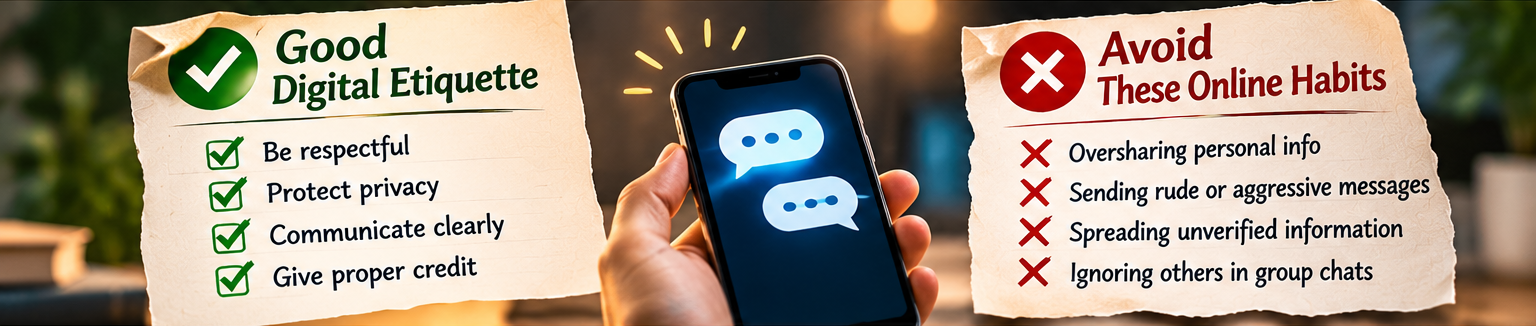
Digital etiquette is the practice of communicating online with clarity, respect, privacy awareness, and accountability. It helps people make better choices in messages, email, group chats, social media, video calls, and shared digital spaces.
Netiquette is not a separate moral system. It is the older, commonly used label for the same practical problem: how people can use digital spaces without treating one another as content, an interruption, or a target. The term does not require everyone to agree. It asks people to disagree without turning a conversation into a pile-on.

Digital manners work best when they are tied to four familiar ideas: courtesy (make communication easier to receive), respect (recognise autonomy and boundaries), integrity (be accurate and own errors), and accountability (repair harm rather than disappearing). Those are the same modern qualities explored in our guides to modern chivalry and chivalry values, applied to screens and networks.
Why does digital etiquette matter?
Online messages travel farther and last longer than a spoken aside. A rushed email can be forwarded. A private photo can be copied. A harsh comment can be read late at night, without tone or context. That does not mean people must write stiffly or fear every mistake. It means the medium adds consequences that are easy to miss when the other person is not in the room.
The U.S. Federal Trade Commission’s privacy guidance explains that sites and apps can collect and use information in ways people may not expect. A practical lesson follows: before sharing someone else’s details, location, image, or message, ask whether they agreed to that audience. A privacy setting is useful, but it is not a substitute for consent.
What are the 10 most important digital etiquette rules?
1. Match the channel to the message
A quick question may belong in a chat. A decision, deadline, or record belongs in email or a shared document. Do not use a group chat to raise a sensitive performance issue that should be private. Choosing the right channel is often kinder than adding more words.
2. Be clear about urgency
“When you get a chance” and “I need this by 3 p.m.” mean different things. Say which one you mean. Repeated calls, all-caps messages, and “???” can create pressure without supplying useful information. If something is genuinely urgent, explain what is needed and why.
3. Do not assume instant access
People may be working, studying, asleep, caring for someone, or simply away from a device. A read receipt does not create an obligation to respond immediately. If a response time matters, agree on it in advance rather than treating silence as disrespect.
4. Ask before you share another person’s content
Forwarding an email, posting a photograph, quoting a direct message, or adding someone to a group can expose them to an audience they did not choose. “Can I share this with the team?” is a small question with a large effect. The FTC’s Share with Care guidance is a useful reminder that online sharing is hard to take back.
5. Read tone twice before sending
Short messages are efficient, but a sentence that sounds neutral in your head may sound irritated on a screen. If the topic is sensitive, name your intent: “I want to make sure I understood,” or “I may be missing context.” This does not weaken a disagreement; it makes the actual disagreement easier to see.
6. Correct errors where they spread
If you repeat false information in a group chat or thread, quietly fixing it only with one person may leave the original harm in place. A brief correction in the same space is usually fairer. The U.S. Cybersecurity and Infrastructure Security Agency’s guidance on recognizing and reporting phishing is also a practical reminder not to amplify a suspicious message before checking it. Our article on performative chivalry explains why visible responsibility matters more than a polished appearance.
7. Keep group chats purposeful
Use threads when they are available, avoid tagging everyone for a matter that concerns two people, and do not turn an unresolved conflict into entertainment for the group. A group chat is not a stage with an endless audience waiting to take sides.
8. Treat video calls as shared space
Join prepared when possible, mute background noise, and avoid recording or taking screenshots without telling participants. If someone cannot turn on a camera or cannot attend live, ask what format would let them contribute. Being present is not the same as being visible on command.
9. Separate criticism from humiliation
Good feedback identifies the decision, impact, and next step. Bad digital etiquette makes a person’s mistake into a joke, a quote-tweet, or a warning to everyone else. If a private conversation can solve it, start there. If a public correction is necessary, keep it factual and proportionate.
10. Repair rather than defend
When you cross a boundary, a useful response is specific: acknowledge what was shared or said, remove it where you can, correct the record if needed, and ask what would help now. “I was only joking” explains intent; it does not automatically repair impact.
Examples of bad digital etiquette—and better alternatives
- Bad: Adding a colleague to a chat late at night and expecting an answer. Better: Send it when convenient, state the deadline, and leave room for their schedule.
- Bad: Posting a friend’s photo because it is flattering to you. Better: Ask before posting, especially if location, children, health, or work details are visible.
- Bad: Correcting someone with sarcasm in front of a large audience. Better: State the correction, link to reliable information if relevant, and avoid turning it personal.
- Bad: Screenshotting a private message for a group. Better: Ask permission or describe the issue without exposing the sender.
- Bad: Sending a vague “we need to talk.” Better: Give enough context to prevent unnecessary anxiety: “Could we discuss the schedule for ten minutes tomorrow?”
How should digital etiquette work at school, work, and home?
Students may need to decide whether a shared answer is collaboration or copying, whether a class group chat is excluding someone, or whether an instructor needs a formal email rather than a late-night message. Professionals may need to set response-time expectations, manage shared documents, and keep sensitive discussions out of public channels. Friends and families face a different version: location sharing, photos, relationship news, and group messages that can blur a boundary without anyone noticing.
The setting changes, but the questions stay close: Who needs to know? Who has consented? What information is missing? Is this message solving a problem, or simply giving me an audience? In close relationships, those questions are part of the wider practice discussed in chivalry in relationships. For examples beyond the internet, see everyday examples of chivalry; that guide owns the wider set of offline and online situations. If you want the broader reason these choices matter, see why chivalry is important.

What should you check before you send, post, or forward?
- Is this accurate, necessary, and clear enough for the audience?
- Would I be comfortable if the person discussed saw this without extra context?
- Am I sharing someone else’s information, image, or message without permission?
- Is there a private or slower channel that would reduce pressure or embarrassment?
- If I am wrong, do I know how I will correct it?
These questions are not a test of whether someone is “good” or “bad.” They are a way to make a moment online more deliberate. If you want to reflect on courtesy, respect, integrity, generosity, and accountability across everyday scenarios, take the Chivalry Test. It is a self-reflection tool, not a diagnosis or a label.
Digital etiquette FAQ
What is the simplest digital etiquette definition?
Digital etiquette is the practice of communicating and behaving online in a clear, respectful, privacy-aware, and accountable way.
What is the difference between digital etiquette and netiquette?
In ordinary use, they overlap. Netiquette is a long-standing term for manners and norms on the internet; digital etiquette is often used more broadly for messages, apps, social media, video calls, and other digital spaces.
Do digital etiquette rules mean I cannot disagree online?
No. They mean a disagreement should address the idea or decision, provide context where needed, and avoid turning another person into a target. Directness and cruelty are not the same thing.
What are common examples of bad digital etiquette?
Common examples include forwarding a private message without permission, posting someone else’s photo or location without asking, sending rude or unclear messages, spreading unverified claims, and using a group chat to shame someone.
Does digital etiquette include privacy and consent?
Yes. Respectful online behavior includes checking who can see a message, image, or recording and asking before you share another person’s content or add them to a new audience.
What are the basic rules of netiquette?
The basics are to use a suitable channel, communicate clearly, respect people’s time and privacy, verify information before sharing it, and correct mistakes without humiliating someone.
Sources and editorial note
- IETF RFC 1855 — Netiquette Guidelines. This 1995 document is informational guidance, not a universal or current legal standard.
- U.S. Federal Trade Commission — How Websites and Apps Collect and Use Your Information.
- U.S. Federal Trade Commission — Share with Care.
- U.S. Cybersecurity and Infrastructure Security Agency — Recognize and Report Phishing.
- The scenarios in this article are original editorial examples, not reported events or personal experiences.
Explore your choices through practical scenarios.
Take the test