The first time I noticed that the Round Table was more than a piece of furniture was while watching a film scene where a dozen armed men sat down as if their swords, reputations, and grudges had suddenly become equal. It is a wonderfully persuasive image. It also makes a promise the stories themselves rarely keep: that power can be shared without rivalry, loyalty without conflict, and honour without cost.
That tension is the reason the Knights of the Round Table still hold attention. They are not a verified group of medieval advisers whose attendance list historians can recover. They are characters in an Arthurian tradition that changed whenever a new writer, performer, publisher, filmmaker, or game maker retold it. The Round Table is a symbol before it is a roster.
This guide explains who the knights are in the stories, why their names change, what the table represents, and where legend ends. For the larger story of how Arthur’s world grew over centuries, read our forthcoming guide to the Arthurian legend. For the real social setting from which later ideas of knightly conduct drew, see our history of chivalry.
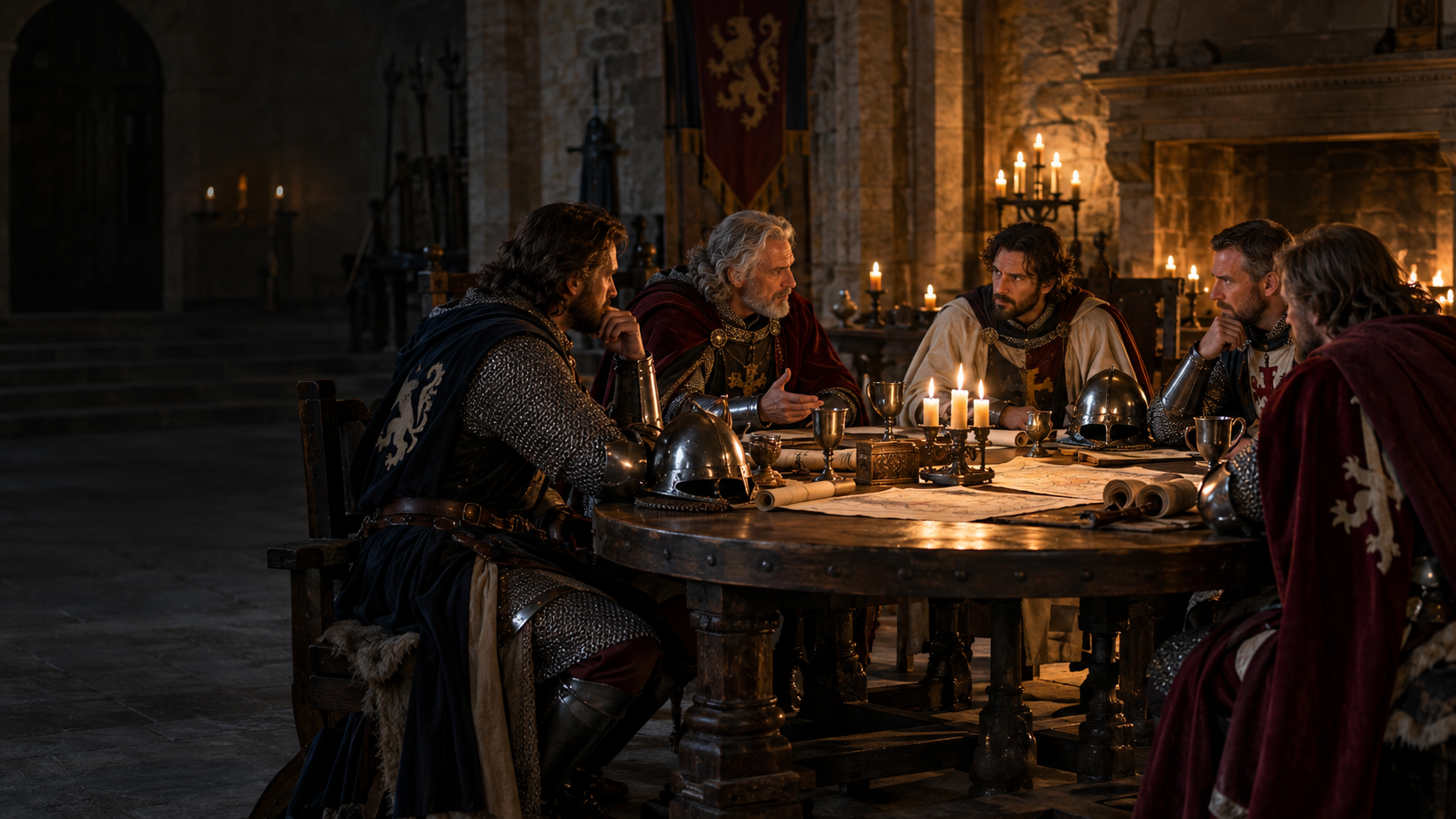
Who were the Knights of the Round Table?
In the familiar version, they are the companions of King Arthur at Camelot. Names often associated with the group include Sir Lancelot, Sir Gawain, Sir Galahad, Sir Percival, Sir Kay, Sir Bors, Sir Tristan, and Sir Bedivere. Guinevere and Merlin are central to many Arthurian stories, but they are not usually presented as knights at the table.
That answer is useful only if we add a warning: there is no single definitive list of Round Table knights names. A reader who expects one official cast will quickly find contradictions. Some characters appear in French romances but not earlier chronicles. Some become central in English retellings. Galahad, for example, is an important Grail figure in later tradition, but he is not an original fixture of every Arthur tale.
The British Library traces this development through manuscripts and writers rather than treating Arthur’s court as a fixed historical record. It notes that accounts of Arthur were written long after the period in which an historical Arthur—if there was one—might have lived. Later writers including Wace, Chrétien de Troyes, and Thomas Malory added, rearranged, and intensified the world readers now recognise. British Library: King Arthur: fable, fact and fiction is a good starting point for seeing the legend as a changing body of stories.
So the honest answer to “who were the Knights of the Round Table?” is: they were literary companions whose identities and importance depended on the version being told. That does not make them less interesting. It explains why a character can feel essential in one book and barely appear in another.
King Arthur and the Round Table
The table belongs to the imagined court of King Arthur and the Round Table, usually called Camelot in later tradition. It is often described as round so that no knight sits at a permanent head of the table. The image suggests fellowship and status shared among people who might otherwise compete for rank.
But equality at the table does not erase differences elsewhere. Arthur is still king. Knights pursue personal honour, family obligations, romances, quests, and alliances. The stories are full of tests of loyalty. Lancelot’s relationship with Guinevere, Gawain’s conflicts and loyalties, and the Grail quest all put pressure on the ideal of a unified fellowship.
That is why the round table meaning is richer than “everyone is equal.” It represents an aspiration: worthy people should be judged by courage, judgement, and loyalty rather than by who gets the most visible seat. It is also a dramatic device. When the ideal breaks, the round shape makes the fracture more visible because the court had claimed to be a circle.
Wace’s Roman de Brut, completed in the twelfth century, is widely credited with introducing the Round Table into the Arthurian tradition. The British Library describes how the table made Arthur appear fair-minded and international in outlook. Later authors gave the idea more characters, more adventures, and more moral pressure. Readers should resist the urge to place every familiar detail into one early source.
The people most readers mean by “the knights”
Here is a practical way to approach the major figures without pretending every version agrees.
Arthur
Arthur is the centre of the court, though not always its most successful knight. In some stories he is the generous ruler who gathers exceptional companions. In others, he misjudges people close to him or cannot prevent the court’s collapse. He is most useful as a ruler under pressure, not as a perfect historical leader.
Lancelot
Lancelot is often portrayed as an extraordinary fighter and a deeply conflicted figure. His love for Guinevere can make him compelling, but it also places private loyalty against public duty. Stories that feature him are not simply saying that talent excuses betrayal; they often use his brilliance to make the consequences harder to ignore.
Gawain
Gawain is one of the oldest and most adaptable Arthurian figures. Depending on the text, he can be courteous, formidable, rash, loyal, wounded by pride, or all of those at once. He is a useful reminder that “Arthurian chivalry” is not a personality test with a stable result.
Galahad, Percival, and Bors
These figures become especially important in Grail stories. Their quests often turn from battlefield success toward spiritual or moral testing. The lesson is not that ordinary people should copy medieval religious ideals. It is that the stories repeatedly ask whether public reputation is the same thing as inner discipline.
Guinevere and Merlin
Guinevere is neither a decorative reward nor a single moral label. Her role changes across texts and is often tied to the court’s political and emotional crisis. Merlin similarly changes from adviser to prophet, enchanter, or destabilising force. Neither should be squeezed into a simple knightly roster simply because both are unforgettable.
Were the Knights of the Round Table real?
There is no reliable historical evidence for a literal Round Table council at Camelot populated by the familiar named characters. There are debates about whether a fifth- or sixth-century leader may have helped inspire part of Arthur’s story, but the surviving accounts were composed centuries later and combine history, imagination, politics, and literary convention.
That distinction matters because the medieval world did have mounted fighters, noble households, tournaments, and ideals of conduct. The Metropolitan Museum of Art explains that knights occupied varied military and social positions; landholding, household service, wages, kinship, and local practice did not follow one neat pattern. Its overview of feudalism and knights is a useful corrective to a film-like picture in which every person in armour is an identical knight.
The legend drew energy from that world, but it is not a documentary report about it. A manuscript scene, a dramatic castle, or a modern game may show what later audiences wanted knighthood to mean. It cannot by itself prove what happened in a particular sixth-century hall.
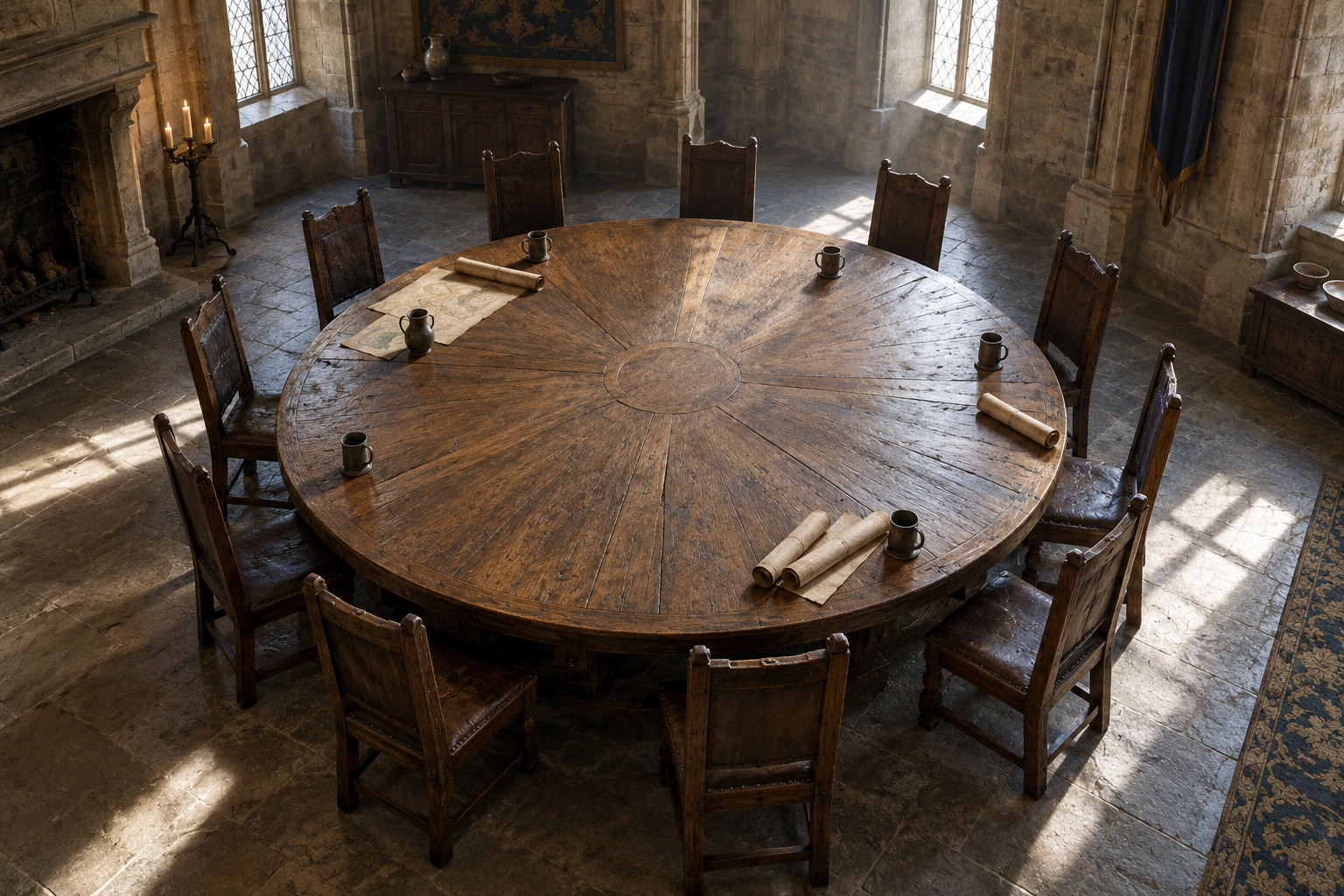
Why does the list of names keep changing?
The short answer is that Arthurian literature has no single owner or master version. Writers inherited material, changed it, and added what suited their audience. Geoffrey of Monmouth helped make Arthur a powerful king in the twelfth century. Wace introduced the Round Table. Chrétien de Troyes developed influential romances and Grail material. The later prose cycles and Malory’s Le Morte d’Arthur brought different strands together for new readers.
That process is exactly what makes the legend durable. A modern reader may come through a novel, a television series, a school book, or a video game. Each can choose a different centre: romance, warfare, magic, betrayal, the Grail, or political duty. Instead of asking which version is the only correct one, ask what the version is trying to explore.
For example, a story focused on Lancelot and Guinevere may test divided loyalty. One focused on Gawain may test pride and recovery. A Grail story may test whether honour can survive self-interest. Those are different questions, which is why this page avoids becoming a general history of all Arthurian stories. The companion Arthurian Legend guide is where the timeline and larger tradition belong.
What can we learn from the Round Table without copying its world?
Modern readers do not need to revive medieval hierarchy or gender rules to find something useful in the symbol. The more honest lessons come from the stories’ failures as well as their grand gestures.
- A seat at the table is not the same as equal influence. Meetings can look open while a few people still control whose ideas are heard. If a team says everyone belongs, it should make room for disagreement, credit, and correction.
- Skill does not cancel responsibility. Lancelot is often exceptional, but the stories do not treat excellence as a free pass from consequences. In modern terms, a talented colleague still needs to keep promises and own mistakes.
- Loyalty needs boundaries. Loyalty to a friend, employer, family, or cause can become harmful when it requires silence about wrongdoing. Our modern chivalry guide explores what respect looks like without rigid roles.
- Grand ideals should survive ordinary decisions. It is easier to praise honour than to give someone fair credit, accept a refusal, or apologise without excuses. The everyday examples of chivalry page focuses on those smaller tests.
These are editorial reflections, not historical claims about an actual Camelot. The stories are useful precisely because they make the mismatch between ideals and conduct visible.
Common mistakes when reading the legend
The first mistake is assuming that every familiar character appears in every version. The second is calling Arthur and his knights “historically proven” because a real medieval object has a Round Table painted on it. The famous Winchester Round Table is a later object associated with the legend, not proof that Arthur’s court met there.
The third mistake is treating the phrase “code of chivalry” as if it were one universally enforced medieval rulebook. The literature offers ideals, but real medieval society was varied and unequal. If you want a careful distinction between selected historical values and the site’s modern reflection framework, compare Seven Values of Chivalry with Five Pillars of Chivalry.
Frequently asked questions
How many Knights of the Round Table were there?
The number changes by source and retelling. Some versions describe a large fellowship; others focus only on a handful of major characters. A precise total without naming the text is usually misleading.
What did the Round Table symbolise?
It commonly symbolises fellowship, shared honour, and the idea that no permanent head seat should dominate the group. In the stories, that ideal is repeatedly challenged by jealousy, ambition, divided loyalties, and failure.
Was Camelot a real place?
Camelot is a legendary court rather than a securely identified historical site. Writers and later audiences have connected it with various places, but the literary Camelot should not be treated as an excavated capital.
Is the Round Table a good leadership model?
It is a useful prompt, not a ready-made management system. Its strongest question is whether a group makes room for truth and responsibility, including when that becomes uncomfortable. A circular seating plan alone does not create fairness.
The enduring point of the legend
The Knights of the Round Table endure because they do not merely show perfect people behaving well. They show a community trying to live up to an ideal and repeatedly discovering how fragile that ideal can be. Arthur’s court remains memorable not because it gives us an unchanging list of names, but because every retelling asks what happens when courage, friendship, love, pride, and power occupy the same table.
If you are interested in how you handle smaller real-life choices—fairness, accountability, generosity, and respect—try the Chivalry Test. It is a reflection tool, not a judgement about character.
Sources and further reading
- British Library — King Arthur: fable, fact and fiction
- Metropolitan Museum of Art — Feudalism and Knights in Medieval Europe
- Metropolitan Museum of Art — Arms and Armor: Common Misconceptions
The historical claims above are supported by these sources. The workplace and personal-conduct examples are original editorial scenarios created for this guide.
Reflect on your choices through practical scenarios.
Take the test