A coat of arms can look like a logo from a world before logos: a bold animal, a repeated colour, a shield shape, and a design recognisable from across a crowded field. That resemblance is useful, but it can also mislead. Medieval heraldry was not simply a collection of cool symbols for anyone to pick from. It developed as a system of identification, family association, display, and regulation that changed across regions and centuries.
Heraldry is the practice and language surrounding coats of arms and related signs of identity. In medieval contexts, visual recognition mattered where armour, distance, ceremony, lineage, and public reputation met. A coat of arms could be connected to a person, a family, an office, or later an institution—but the exact rules varied.
This page explains heraldry as visual identification. It does not retell every tournament or order of knighthood. Those subjects have their own pages: Medieval Tournaments explains the event culture, while Orders of Chivalry will focus on honours institutions.
What is medieval heraldry?
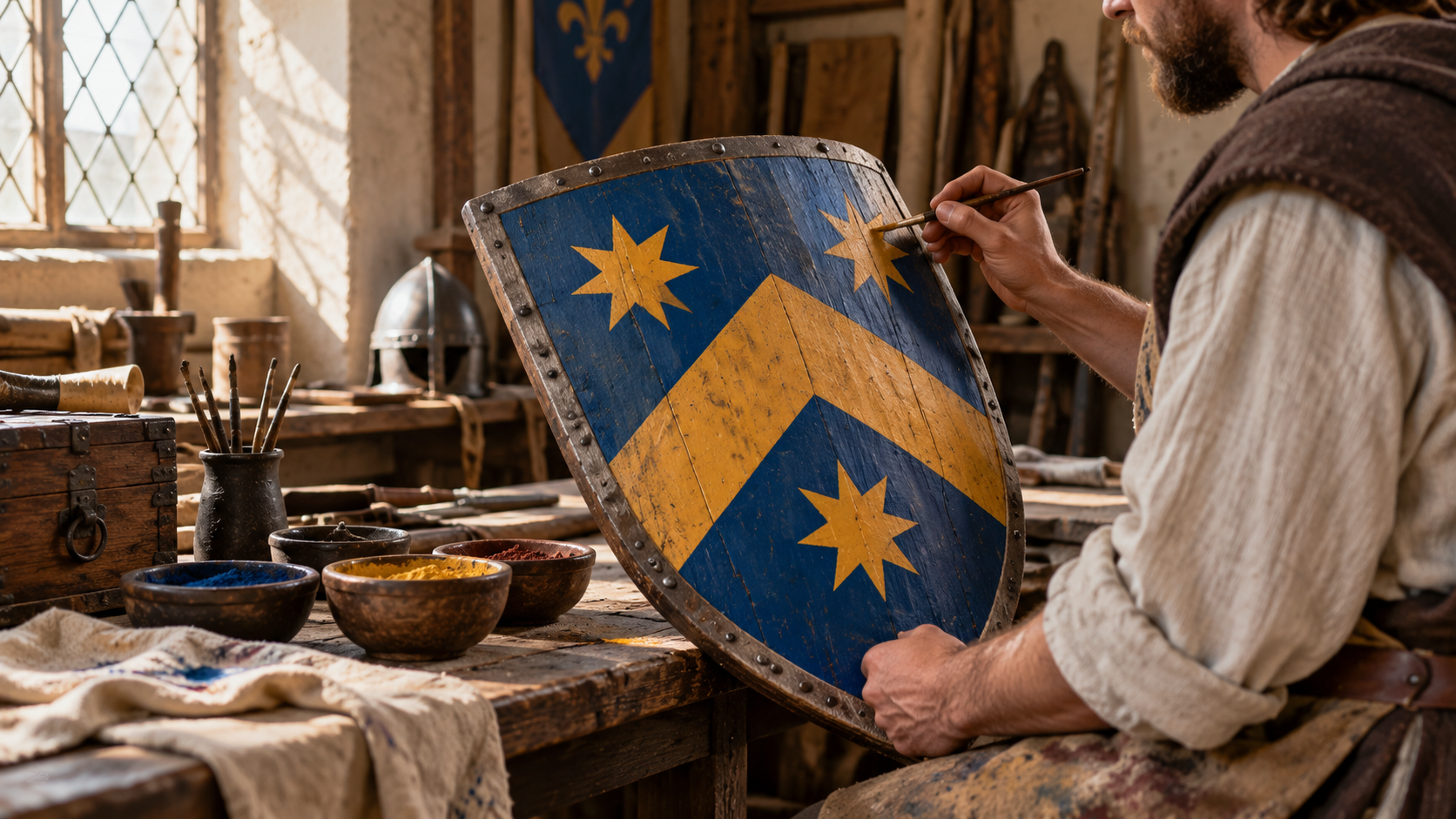
Heraldry refers to the organised use and description of armorial designs: shields, crests, banners, and related symbols. It developed in medieval Europe in a world where visual distinction could matter in warfare, tournaments, seals, public ceremony, and family representation.
The Met notes that heraldry continued to flourish and became more complex even as knights gradually lost some battlefield importance. That single observation helps explain why heraldry cannot be reduced to combat identification. It was also about status, memory, property, kinship, and display. The Met’s overview of feudalism and knights gives useful context for that change.
What is on a coat of arms?
A simplified coat of arms may include several elements:
- Shield: the central field carrying the main design.
- Colours and metals: heraldic terms are used for particular colours and metallic tones.
- Charges: figures or shapes placed on the shield, such as animals, stars, crosses, or geometric forms.
- Crest: an element shown above a helmet in many later depictions.
- Motto: a phrase associated with some arms, but not every design needs one.
It is tempting to treat every lion, eagle, or star as a fixed universal code. Usually that is too simple. A lion can appear for many reasons; meaning depends on the particular arms, owner, period, and context. A visual motif is not a personality quiz.
Why heraldry mattered
In a tournament field, on a seal, or in a manuscript, marks of identity could help an audience connect a person or household with reputation and lineage. Heralds and artists played roles in recording, describing, and displaying arms. The system became a language with conventions, but it was not identical everywhere.
This is why medieval heraldry overlaps with tournament culture without being the same thing. A banner in a joust could identify a participant; it could also make their social ties visible. The Medieval Jousting guide focuses on the contest mechanics. Here, the interest is the visual system that made identity legible.
Heraldry is not a free symbol generator
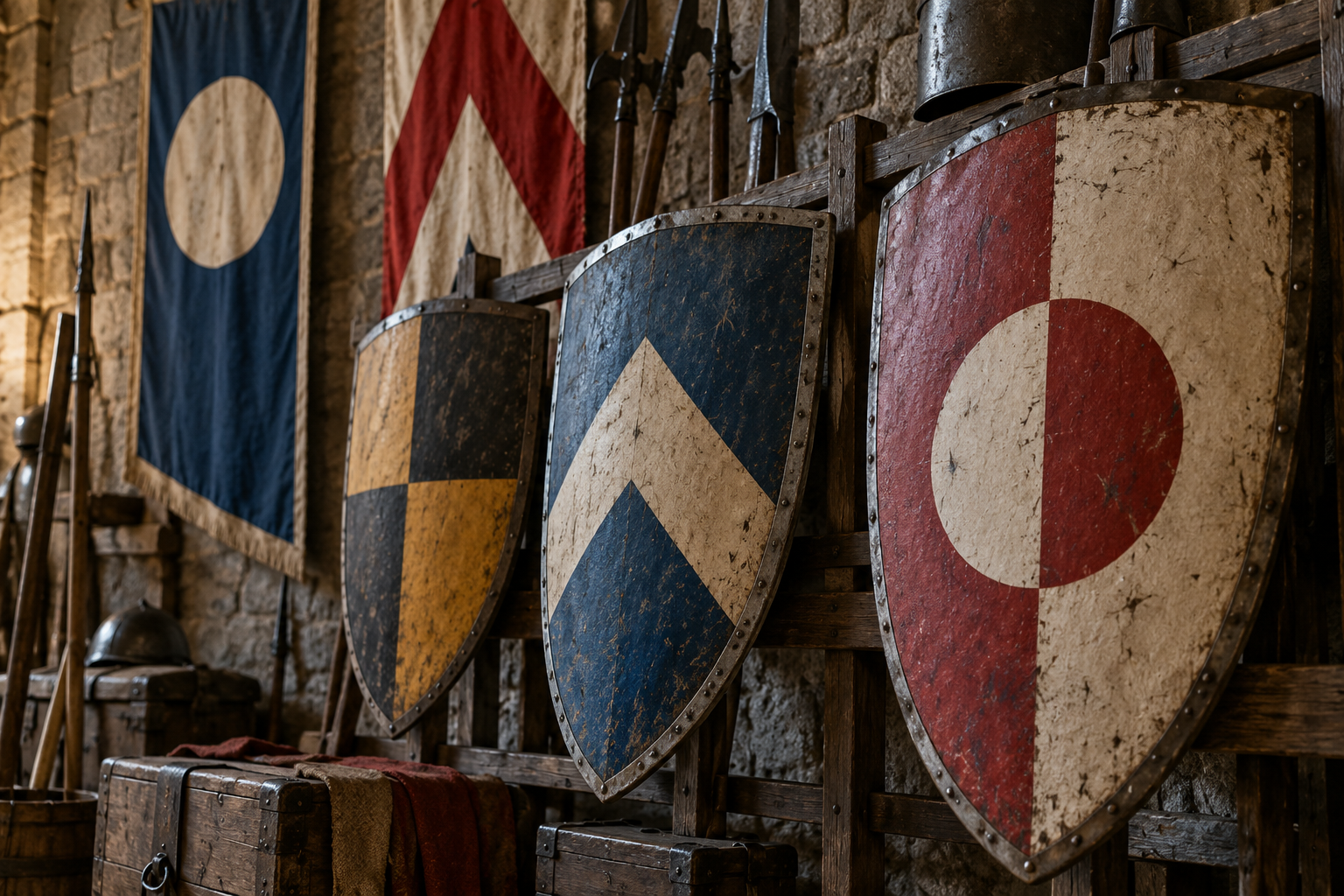
Online tools often promise a “family crest” based on a surname or personality. Be careful. A coat of arms is not automatically shared by every person with the same last name. In traditions where armorial bearings are regulated, entitlement and inheritance can be specific. Buying decorative artwork does not grant a legal or historical right to an existing coat of arms.
The same caution applies to invented medieval claims. A design can be meaningful to a family today without pretending it belonged to ancestors in 1250. A clear sentence—“this is a modern family emblem inspired by heraldry”—is more respectful than an unsupported claim of ancient entitlement.
Heraldry, orders, and public institutions
Heraldic symbols also appear around institutions and honours. In the United Kingdom, the Royal Family’s official material explains that the Sovereign’s arms have developed over time and that certain symbols are used in specific official contexts. The Royal Family’s coats of arms information is a better source for current official use than a decorative-crest website.
That does not mean every coat of arms is royal, nor that an order of chivalry is simply a badge. An order is an institution with its own history and rules. Heraldic signs can be part of its visual identity, but the two ideas do different jobs.
Reading a heraldic image carefully
Try these questions before drawing a conclusion from an image:
- Who made the image, and when?
- Is it a seal, a manuscript illustration, a later painting, a modern reconstruction, or a commercial design?
- Does it identify a real person, family, office, or place?
- Are the colours and elements being described from a reliable source, or guessed from a low-quality reproduction?
- Is the image being used as evidence for a claim it cannot actually prove?
The questions are simple, but they prevent a common mistake: seeing an attractive shield and treating it as a full biography of the person connected with it.
What survives in modern life
Heraldic ideas survive in civic arms, schools, universities, sports identities, military insignia, ceremonial institutions, and family-history projects. Modern design often borrows the visual vocabulary because it communicates continuity and belonging quickly.
Borrowing a style is not the same as inheriting a medieval right. The honest modern use is creative and transparent: cite inspiration, avoid copying a protected or official symbol, and do not make false ancestry claims. The same principle applies to all historical imagery on this site; our article visuals are clearly labelled AI-generated illustrations rather than artefacts.
Common mistakes
- Treating every surname as having one shared family crest.
- Assuming a symbol has one universal meaning across Europe and every century.
- Confusing a coat of arms with a logo, trademark, or personal personality test.
- Using a decorative image as evidence of ancestry or legal entitlement.
- Calling every colourful medieval shield a historically verified coat of arms.
Frequently asked questions
Did every knight have a coat of arms?
No simple rule covers every place and period. Heraldic practice developed over time and was shaped by status, region, and recordkeeping.
Can I create my own coat of arms?
You can create a personal emblem, but avoid claiming it is an inherited or officially granted coat of arms unless you have evidence and follow the relevant jurisdiction’s rules.
What is the difference between a crest and a coat of arms?
In strict heraldic use, a crest is one component that may appear above a helmet; a coat of arms refers more broadly to the armorial achievement or shield design. Everyday usage often mixes the terms.
Are heraldic symbols still used today?
Yes, by some public, civic, educational, and ceremonial bodies, often under specific rules and contexts.
A language of identity, not a shortcut to identity
Heraldry remains compelling because it turns affiliation, memory, and status into a concentrated visual language. Its real interest is not that a lion can magically reveal a personality. It is that people created systems for being recognised in public—and those systems still influence how institutions and families present themselves today.
For a modern, values-based reflection rather than a historical identity claim, take the Chivalry Test. It asks about present-day choices, not lineage.
Sources and note
- Metropolitan Museum of Art — Feudalism and Knights in Medieval Europe
- The Royal Family — Coats of Arms
The examples and visual analysis are original editorial content. The illustrated shields on this page are fictional and do not identify real families.
Reflect on your choices through practical scenarios.
Take the test