It is easy to call every armoured event a tournament. A rider charges with a lance, banners hang from a stand, people cheer, and the label feels close enough. Historically, though, medieval tournaments were broader, messier, and more revealing than a single jousting pass. They brought together martial practice, reputation, money, spectacle, travel, law, craft, and local power.
A tournament could include jousts, but it was not merely a series of jousts. Earlier forms could involve organised group encounters that looked much closer to large-scale martial exercises than the later barrier contests most people picture. Over time, rules, ceremony, armour, prizes, and spectators changed what a tournament could be.
This page is about the event as a whole. If your question is specifically how two riders met with lances, read Medieval Jousting. If your question is how a person’s status and equipment fit the wider medieval world, read Knighthood.
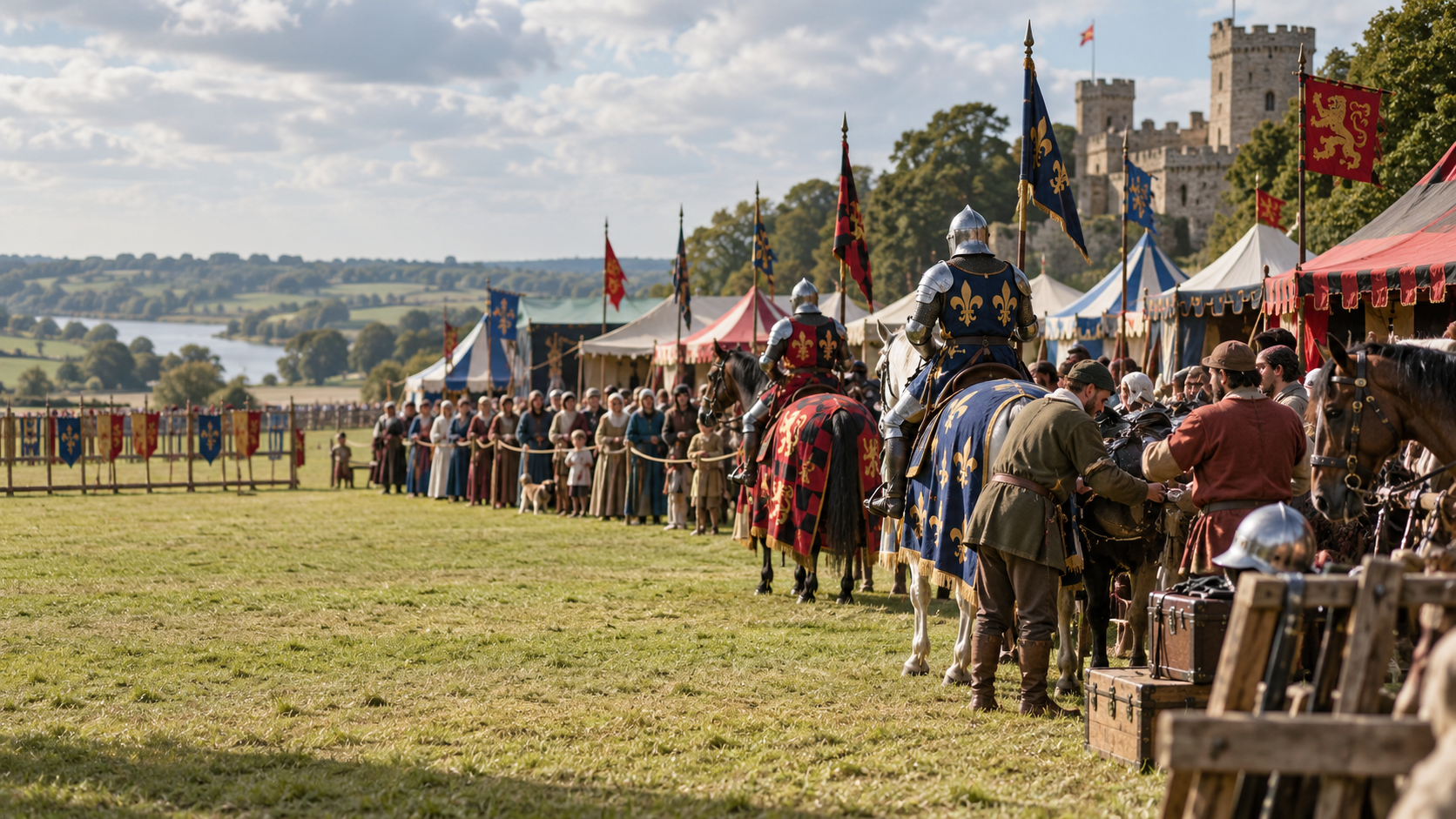
What were medieval tournaments?
Medieval tournaments were organised martial events whose forms changed over centuries. They could involve mounted competitions, group fighting traditions, pageantry, heralds, prizes, feasts, and political display. The word describes a category of event, not one unchanging game.
The Met notes that tournaments became increasingly magnificent even as battlefield conditions changed and knightly military importance shifted. That observation matters because it shows why a tournament cannot be reduced to “practice for war.” It had martial roots, but it could also be a place where elites displayed wealth, skill, alliances, and identity. The Metropolitan Museum of Art’s overview gives the essential wider context.
Tournament, mêlée, and joust
The distinctions are useful, even if real historical events did not always fit tidy modern categories.
- A mêlée involved groups of mounted participants in a large contest. Earlier tournaments could be far more open and dangerous than later enclosed events.
- A joust was a more focused encounter between individual mounted riders, often using lances.
- A tournament could include either or both, along with ceremony, judging, display, and social events.
This vocabulary helps prevent a common error: reading a late-medieval painting of a barrier joust back into every earlier tournament. Historical change is part of the story, not a complication to skip.
Why were tournaments important?
For participants, a tournament could offer reputation, patronage, prizes, networks, and a chance to demonstrate expertise. For hosts, it could advertise wealth, authority, or a political connection. For spectators, it could be entertainment, ceremony, and a chance to see social rank displayed in public.
That public display had a visual language. Banners, shields, colours, horses, clothing, and heralds could help identify people and households. The future Medieval Heraldry article will handle that language directly. The point here is that visual display was part of how a tournament worked; it was not merely decorative background.
Tournaments also depended on labour that stories sometimes hide: armourers, smiths, grooms, cooks, organisers, servants, riders, musicians, and local workers. The image of a lone knight winning honour is incomplete without the people and material resources that made the event possible.
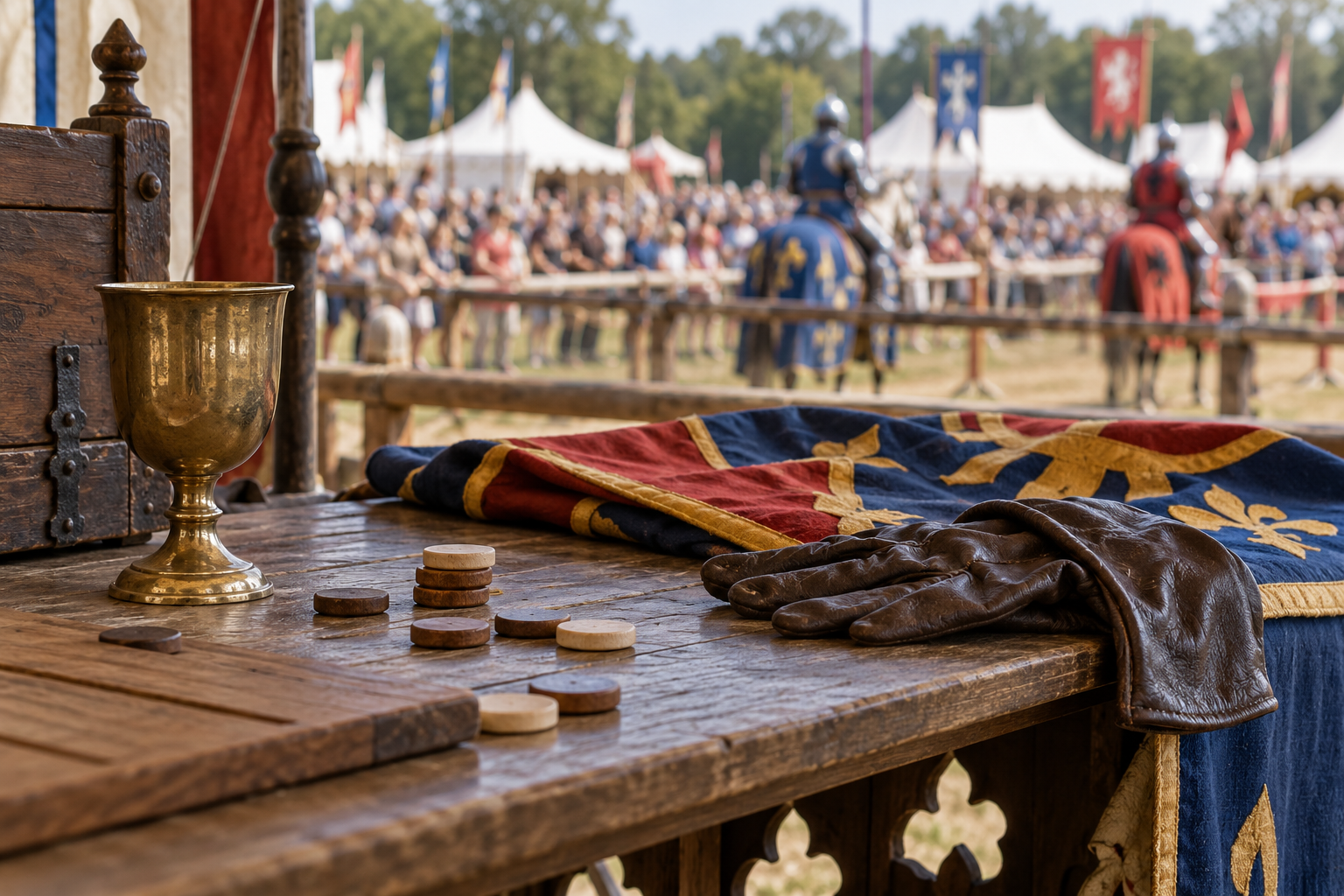
Were tournaments like modern sports?
There are similarities: rules, audiences, sponsorship-like patronage, rivalries, skill, performance, and arguments about fairness. But a medieval tournament existed inside a society with very different law, violence, wealth, and status. Calling it a sport can be useful only if the differences remain visible.
A modern regulated sport has standardised institutions and safety expectations that did not exist in the same form across medieval Europe. A tournament could be ceremonial, but it could also carry risk, political tension, and economic consequences. There was no universal event manual used everywhere for centuries.
Tournaments and chivalric ideals
Tournaments are closely associated with chivalry because they staged ideals in public: courage, controlled aggression, generosity, courtesy, and reputation. Yet staging an ideal is not the same as living it. A participant could look magnificent while behaving badly. A host could celebrate honour while excluding people or escalating local competition.
This gap is valuable to notice. It prevents the word chivalry from becoming an automatic compliment. Our Chivalry Facts guide separates common myths from evidence, while Performative Chivalry examines the modern version of the same question: when does a gesture become mainly a performance for an audience?
How did tournaments change?
Several broad shifts are worth remembering:
- Early group contests could be wide-ranging and difficult to control.
- Individual jousting and more formal conditions grew in prominence in many late-medieval settings.
- Armour and equipment adapted to different uses, including tournaments.
- Courts and cities used events for ceremony and display.
- As warfare changed, tournament traditions continued as cultural performance and memory.
These points are intentionally broad. A specific century, kingdom, or manuscript may show a more detailed local picture. Good historical writing names its scope rather than pretending one summary fits all places.
What can a modern reader learn from tournaments?
Not that life should become a contest. The useful lesson is that public standards need private accountability. An event can have splendid symbols, polished rules, and a noble slogan while still rewarding the wrong behaviour. That is true in sport, workplaces, schools, and online communities.
Before praising a group’s “culture,” ask who is allowed to participate, how disputes are handled, whether rules protect the vulnerable, and whether credit follows real contribution. Those are modern questions; they are not claims about what every medieval organiser believed. They are a way of using history without turning it into costume advice.
Common mistakes
- Using “joust” and “tournament” as interchangeable words.
- Assuming a modern film version shows one historical standard.
- Treating a tournament as either pure sport or pure war instead of a changing mix of martial, social, and political functions.
- Forgetting the labour, animals, and resources behind elite display.
- Calling tournament ceremony proof that participants always behaved honourably.
Frequently asked questions
Were tournaments always dangerous?
Risk was part of them, although forms and controls varied. Ceremony and rules did not make weapons, horses, or crowds harmless.
Did common people attend tournaments?
Access and participation varied by place and event. A tournament could draw wider public attention while still being structured around elite participants and patrons.
What did a winner receive?
Prizes, reputation, equipment, patronage, and social recognition could all matter, but the details depended on the event and period.
Are modern medieval festivals accurate?
They can be educational or entertaining, but each is an interpretation. Ask which sources and safety adaptations inform the presentation.
The event behind the image
The most useful way to see medieval tournaments is as events built around more than impact. They made identity public, tested skill in front of an audience, created stories about honour, and exposed the difference between an ideal and the people trying to perform it. That makes them historically richer than a single dramatic charge.
For a modern reflection on responsibility without romanticising the past, try the Chivalry Test. It uses ordinary scenarios, not historical contests.
Sources and note
- Metropolitan Museum of Art — Feudalism and Knights in Medieval Europe
- Metropolitan Museum of Art — Arms and Armor: Common Misconceptions
The historical framework is supported by these sources. The modern comparisons are original editorial interpretation.
Reflect on your choices through practical scenarios.
Take the test