The modern image of a joust is simple: two riders lower lances, collide, and somebody flies from a horse. It is a great image for a poster because it captures danger in a single second. It is also only the last visible moment of a much larger operation involving horses, training, armour, rules, spectators, money, reputation, and organisers.
Medieval jousting was a mounted contest between individual riders, usually with lances. It could be part of a wider tournament, but it was not identical to the tournament itself. That distinction matters. A joust focuses on the paired encounter; a tournament could include several events and, in earlier periods, much rougher group fighting.
This guide explains the joust as a historical practice and a modern re-enactment subject. It does not try to cover every type of medieval tournament—that is the job of our Medieval Tournaments guide. For the broader world of arms, service, and knightly status, read Knighthood.
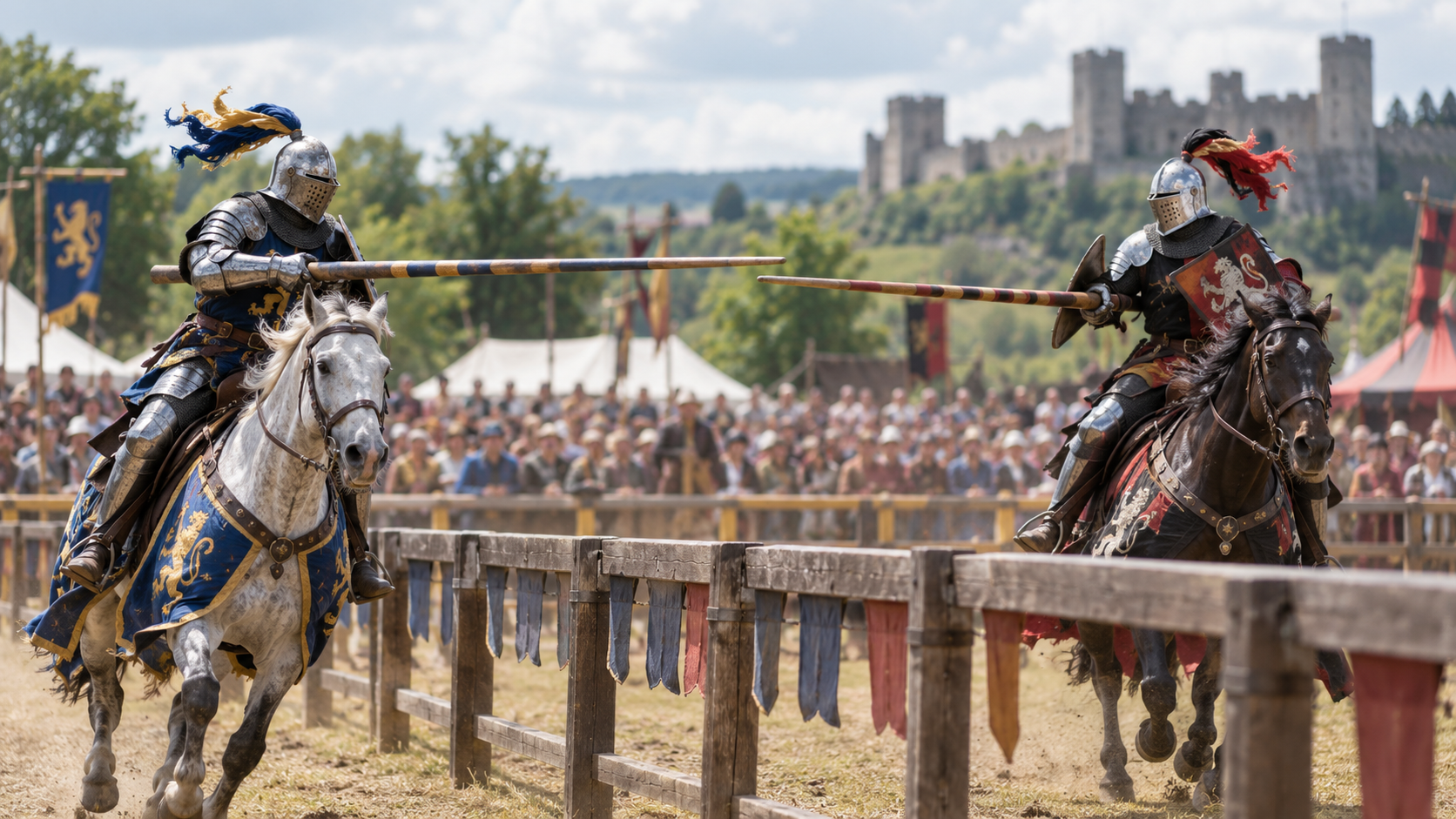
What was medieval jousting?
Jousting involved two mounted competitors making passes at one another with lances. Depending on period and context, the aim could include striking a shield or target area, breaking a lance, unhorsing an opponent, or demonstrating control and skill. Specific rules were not fixed across all medieval Europe. Equipment, scoring, barriers, and ceremony developed over time.
The Metropolitan Museum of Art notes that tournaments grew in magnificence even as knights gradually lost some military importance on the battlefield. That is an important clue. Jousting was connected to martial culture, but it also became a display of status, craft, spectacle, and controlled competition. The Met’s overview of feudalism and knights provides the larger context.
Calling it “just a sport” misses the point. Calling it a direct rehearsal for war misses a different point. It had practical martial roots, yet a formal joust could be governed by expectations that made it unlike battlefield combat. Like modern combat sports, it sat somewhere between serious skill, public performance, status, and risk.
The anatomy of a joust
Although details changed, a reader can picture several recurring parts.
The horse
The horse was not a background prop. A rider needed control, timing, and a trained mount able to charge in a narrow line. Horses had different uses and values, and a wealthy competitor’s resources could affect equipment and preparation. That is one reason jousting should not be treated as an activity available to everyone on equal terms.
The lance
A lance was long enough to transmit force through a fast-moving mounted pass. In a formal joust, the shape and preparation of equipment could be adapted for the event. Broken lances made a strong visual record of contact, but a shattered lance does not automatically tell us the full scoring system for every contest.
Armour and protection
Armour evolved with use. Tournament gear could differ from equipment intended for campaigning. The Met’s guide to arms and armour misconceptions is useful here: people in armour were not all identical knights, and armour was not a magical guarantee of safety.
The lists and barrier
The fenced or marked area for a contest is often called the lists. A central barrier, commonly associated with later jousting forms, helped riders pass on predictable sides. It changed the movement and reduced the chance of head-on collision, but it did not remove danger.
Judges, heralds, and spectators
Jousts had audiences. Organisers needed ways to identify participants, enforce expectations, settle disagreements, and announce outcomes. Heraldry became important in this public world of recognition and display. The future Medieval Heraldry guide focuses on how visual identification worked rather than repeating jousting history.
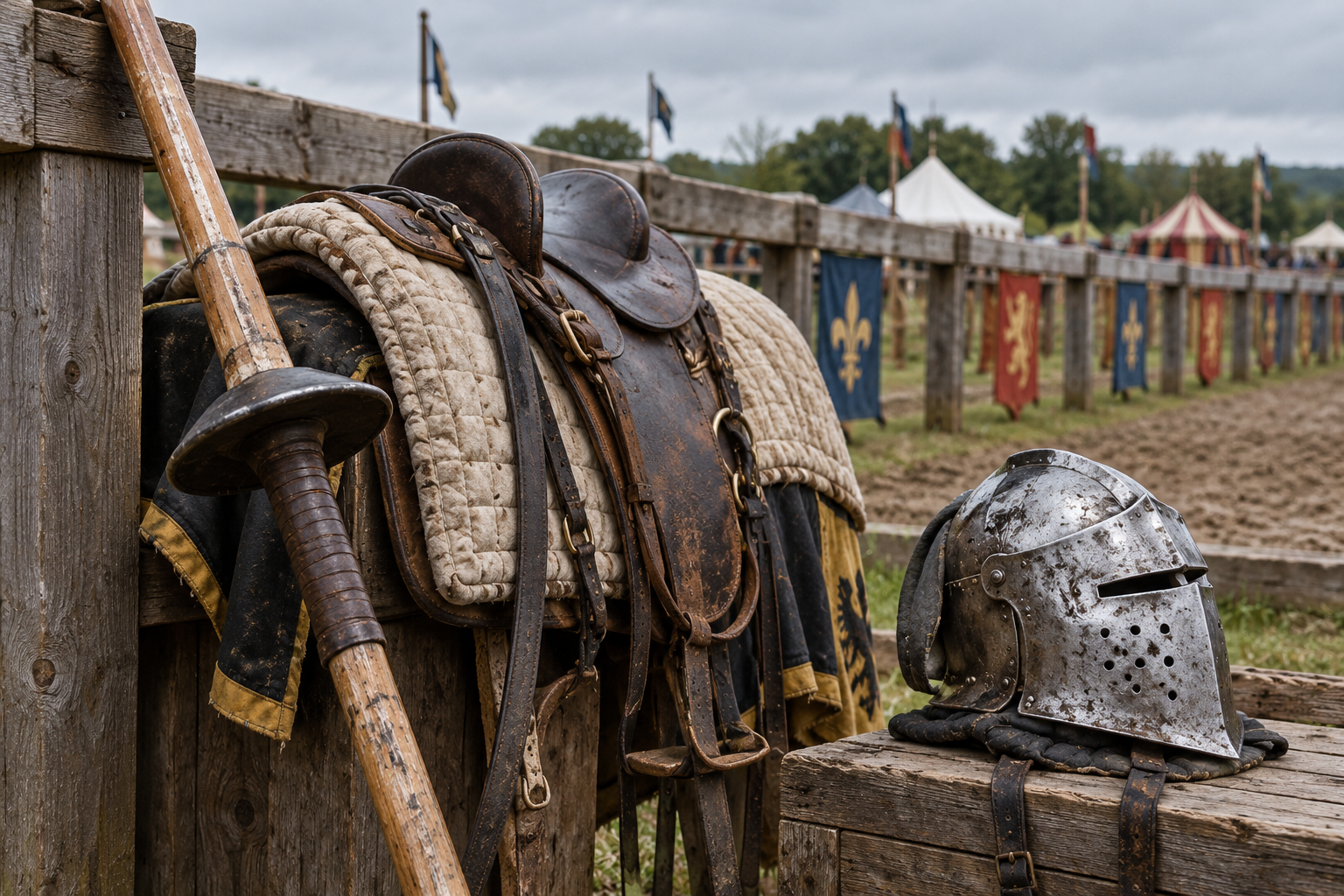
Was jousting dangerous?
Yes. Controlled rules could reduce some risks, but speed, height, weight, animals, weapons, and heavy equipment still made injury possible. A medieval contest was not safe because it had ceremony. It could be dangerous precisely because spectators expected riders to show commitment and skill under pressure.
It is tempting to make the danger the whole story. That creates a misleading picture too. Jousting required restraint. A competitor who ignored agreed conditions could damage reputation as well as bodies. This is one place where the word “chivalry” needs care: ideals of honour may have shaped how people wanted a contest to look, but they did not erase rivalry, money, social inequality, or real harm.
Jousting versus medieval tournaments
The difference is simple and worth repeating:
- A joust is usually a contest between two mounted individuals.
- A tournament is a broader event that could include jousts, displays, feasts, group combat traditions, judging, and spectators.
Older tournaments could look very different from the later barrier joust familiar from paintings and films. Do not assume an event from one century had the same rules, armour, or goals as an event from another. This guide uses “medieval jousting” for the individual contest and sends the wider event history to its own page to avoid conflating two distinct topics.
Is jousting still practised today?
Versions of jousting are still presented by historical re-enactment groups, riding organisations, and staged events. A modern performance is not automatically a reconstruction of a specific medieval rule set. Its safety equipment, animal welfare rules, insurance, venue, and audience expectations are modern realities.
If you are interested in jousting today or historical re-enactment, look for organisations that state their safety procedures, horse-care standards, and historical sources. Do not try to imitate online clips with improvised equipment. A lance, moving horse, and collision risk are not an at-home project.
The best question for a spectator is not “is this exactly medieval?” It is “what period or tradition is this group interpreting, what adaptations have they made, and how do they keep people and animals safe?” That produces a more honest appreciation than claiming total authenticity.
What jousting can teach without romanticising violence
Jousting stories can make skill and courage visible, but the better modern lesson is not to imitate combat. It is to notice that preparation and restraint matter when stakes are high. A rider needed more than bravery: judgement, practice, awareness of equipment, and respect for agreed limits all mattered.
That is close to the modern idea of integrity we discuss in Five Pillars of Chivalry. The comparison is only a reflection, not a claim that a modern office or relationship is a tournament. The point is smaller: confidence without control can become reckless; rules without accountability become decoration.
Common mistakes
- Treating a joust and a tournament as the same event.
- Assuming all medieval jousts had a central barrier or the same scoring.
- Calling armour proof that an event was safe.
- Assuming every participant was a noble knight with equal resources.
- Treating modern performance jousting as an unchanged medieval survival.
Frequently asked questions
Did knights die in jousts?
Serious injury and death could occur. The exact risk depended on event, equipment, period, and circumstances. Ceremony reduced neither speed nor impact to zero.
What is the barrier in a joust called?
It is commonly called a tilt or tilt barrier in later jousting contexts. It guided riders to pass on set sides.
Was jousting used to train for war?
It had martial connections, but formal jousting also had its own rules, social meaning, and display. It should not be treated as a simple copy of battlefield fighting.
Can anyone try jousting today?
Do not attempt it casually. Seek qualified equestrian and event professionals who use modern safety systems and established procedures.
The real drama is preparation
The collision gets remembered because it is easy to see. The preparation is what makes jousting historically interesting: a world of horses, craft, identity, audience, competition, and risk. Seeing that wider picture gives more respect to the people and animals involved, and less power to the fantasy that courage is only a matter of charging faster.
For a modern, non-combat reflection on restraint and responsibility, take the Chivalry Test. It uses everyday situations, not historical reenactment, to prompt thought about choices.
Sources and note
- Metropolitan Museum of Art — Feudalism and Knights in Medieval Europe
- Metropolitan Museum of Art — Arms and Armor: Common Misconceptions
This article’s explanatory scenarios are original. The images are illustrative and are not used as historical evidence.
Reflect on your choices through practical scenarios.
Take the test